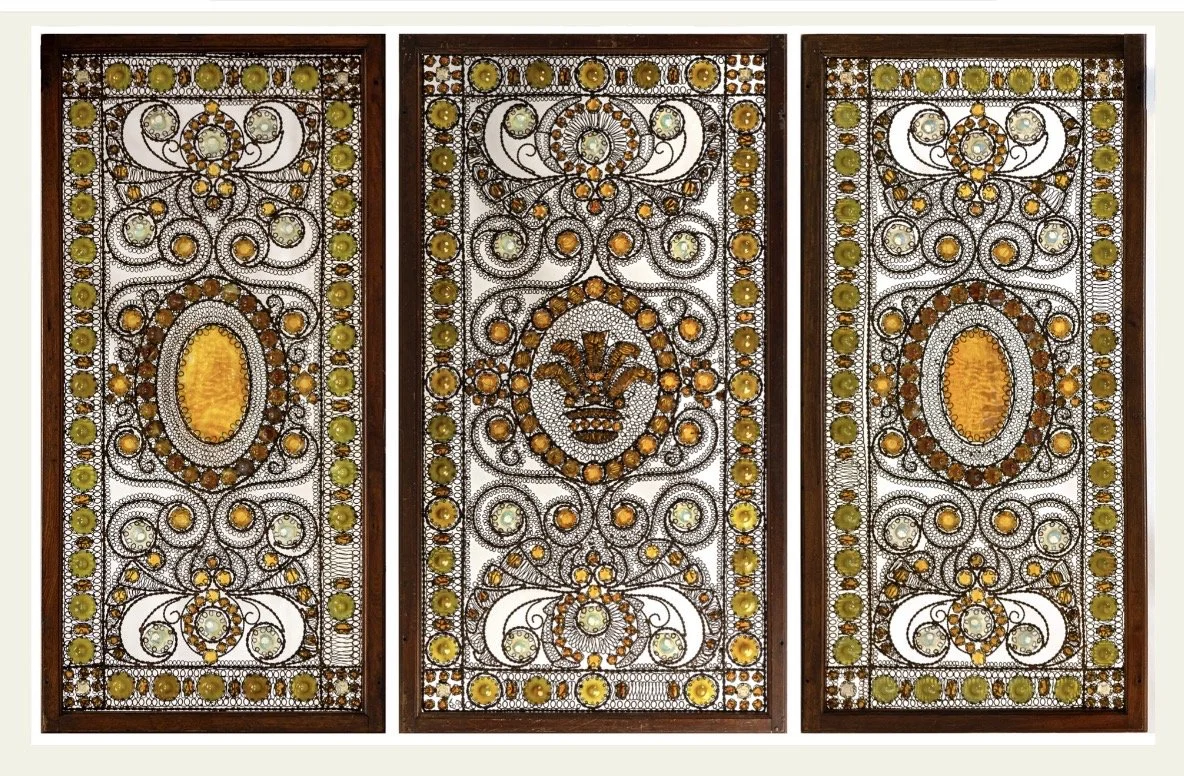
Tiffany Twisted Wire Jeweled Screens
Louis Comfort Tiffany, New York, C.1881-1883
Copper wire coated with bronze powder, twisted and scrolled; opalescent and amber glass cabochons and chipped glass jewels; opalescent sheet glass.
Twisted wire, set with glass jewels, was one of Louis Comfort Tiffany’s signature decorative techniques from the arly 1880s to the early 1990s, drawn from Islamic, Indian, and Byzantine sources.
Tiffany’s Early Career
Tiffany led Associated Artists with Candace Wheeler, Samuel Colman, and Lockwood deForest. The partnership decorated the Mark Twain House in Hartford in 1881 and the White house in 1882-83, the dissolved in 1883 when Tiffany’s firm became independent.
The technique reached its peak in the Henry O. Havemeyer house, New York, decorated by Tiffany and Colman in 1890-91. Its entrance hall firescreen and staircase balustrade wrapped gilded wire curls around opalescent glass. The same wirework appeared on the tabernacle door of Tiffany’s chapel for the 1893 Chicago World’s Columbian Exposition, and later in Tiffany’s Art Jewelry.