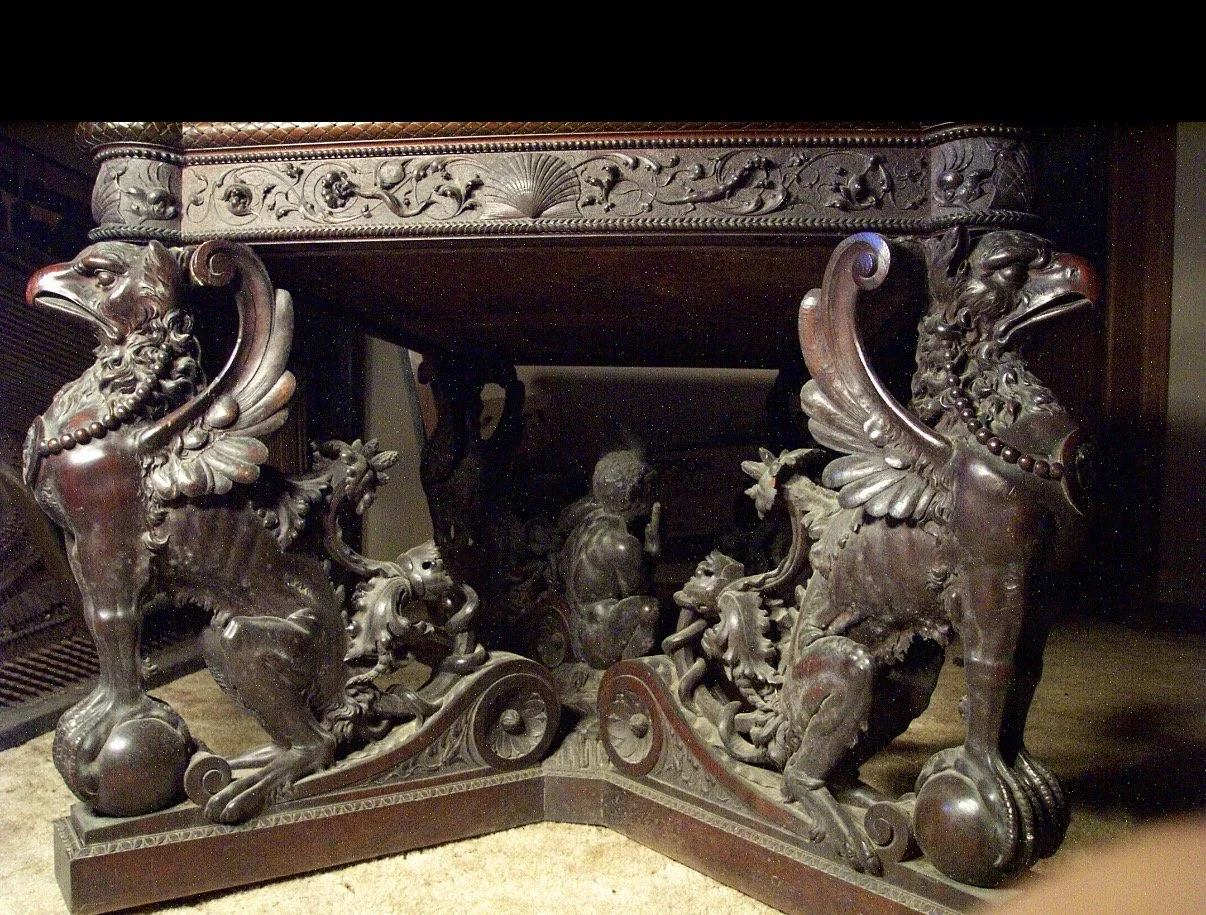
Luigi Frullini Library Suite
Luigi Frullini, Florence, Italy, 1873
Most likely Originally from “Linden Gate,” Newport, Rhode Island, (1873-1973), Summer home of Henry G. Marquand, and descended through his family to Roderick Terry , Jr. (1876-1951).
This outstanding library suite is a fanciful creation of the highest quality. Consisting of a library table, armchair, two side chairs, and two substantial bookcases. While the gryphons supporting the table become the focus of the suite, the tiniest lizards and butterflies are given equal attention in their creation. With a seaside theme continuing through each piece with prominently placed seashells, they also include classical decorative elements.
Luigi Frullini, Florence, Italy (1839-1897)
Luigi Frullini was a Florentine wood carver who helped turn decorative carving from a craft into a recognized art in the later 19th century. He was the son of a struggling artist and had little formal schooling, starting work at age twelve in a Florentine workshop that copied antique furniture, which was in demand as collectors gathered old Italian Pieces. He rose quickly to foreman, and his master soon let him carve his own designs. After studying modelling, design, and architecture at the Florence Academy of Fine Arts, he briefly tried sculpting, but his love for woodworking brought him back to the furniture workshops. Woodworking answered to his touch in a way that marble did not
With no living masters to follow, he studied 15th century carvings and worked directly from nature. Forging an entire array of woodworking tools to duplicate the tool marks of those ancient artists, he singlehandedly revived this lost art.
His bench was covered with real flowers and leaved, and he carved straingt into the final block without sketches. He was known for his botanical accuracy: he refused to combine flowers that don’t bloom in the same season. His chubby putti were his best-known subjects, comparable to Donatello’s. He won the Legion of Honor after showing The Dance of the Hours in Paris and received honors in England. He left a school of followers, though none matched his talents.