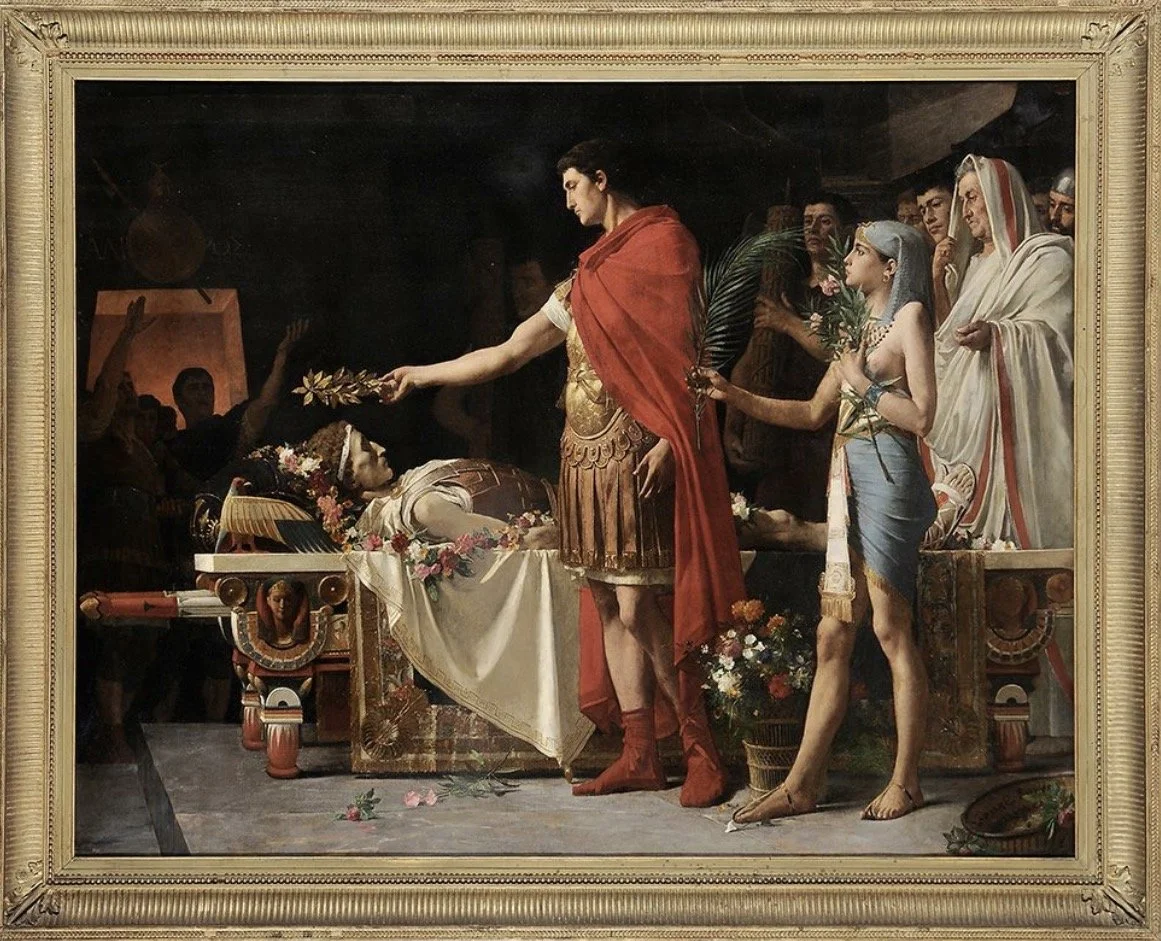
Lionel Royer, Funeral of Julius Caesar
Lionel Noël Royer, French (1852-1926)
Cleopatra and Mark Antony at the Funeral Bier of Julius Caesar, 1878, signed
This scene is full of rich color and even richer history. While the body of Caesar lies upon a richly appointed bier, he is the focus of a scene charged with grief, ambition, and the first stirrings of the political struggle that will follow his death.
Beside him stands Mark Antony, magnificent in gilded armor and a sweeping crimson cloak. He reaches toward the fallen Caesar with a branch of laurel, a final tribute to the murdered dictator and a symbol of the glory that died with him. Antony’s commanding presence dominates the composition, yet the gesture itself is unexpectedly tender: soldier, statesman, and friend paying homage to the man whose assassination has thrown Rome into chaos.
Beside Antony stands the slight figure of Cleopatra, Queen of Egypt and Caesar’s former lover. Draped in pale blue-green and carrying flowers, she is portrayed not as the exotic sovereign of legend but as a woman confronting the death of the man with whom her own fortunes—and those of Egypt—had become profoundly entwined. Her quiet composure forms a striking counterpoint to Antony’s martial splendor. She looks up to Mark Antony, the man with whom she will next cast her lot.
Almost lost in the shadows, Octavian, the young heir of Caesar, provides an ominous note. With his arms thrown upward in an agitated gesture, he seems already to belong to the turmoil beyond the funeral chamber. Caesar’s death has created a vacuum, and Antony and Octavian will soon become rivals for his political inheritance. Cleopatra, standing between their worlds, will ultimately become inseparable from that struggle.
The artist therefore gives us more than a funeral. Around Caesar’s corpse stand three people whose lives will determine what happens next. Antony will join his fate to Cleopatra’s; Octavian will destroy them both; and from the collapse of the Roman Republic he will emerge as the first Emperor of Rome.