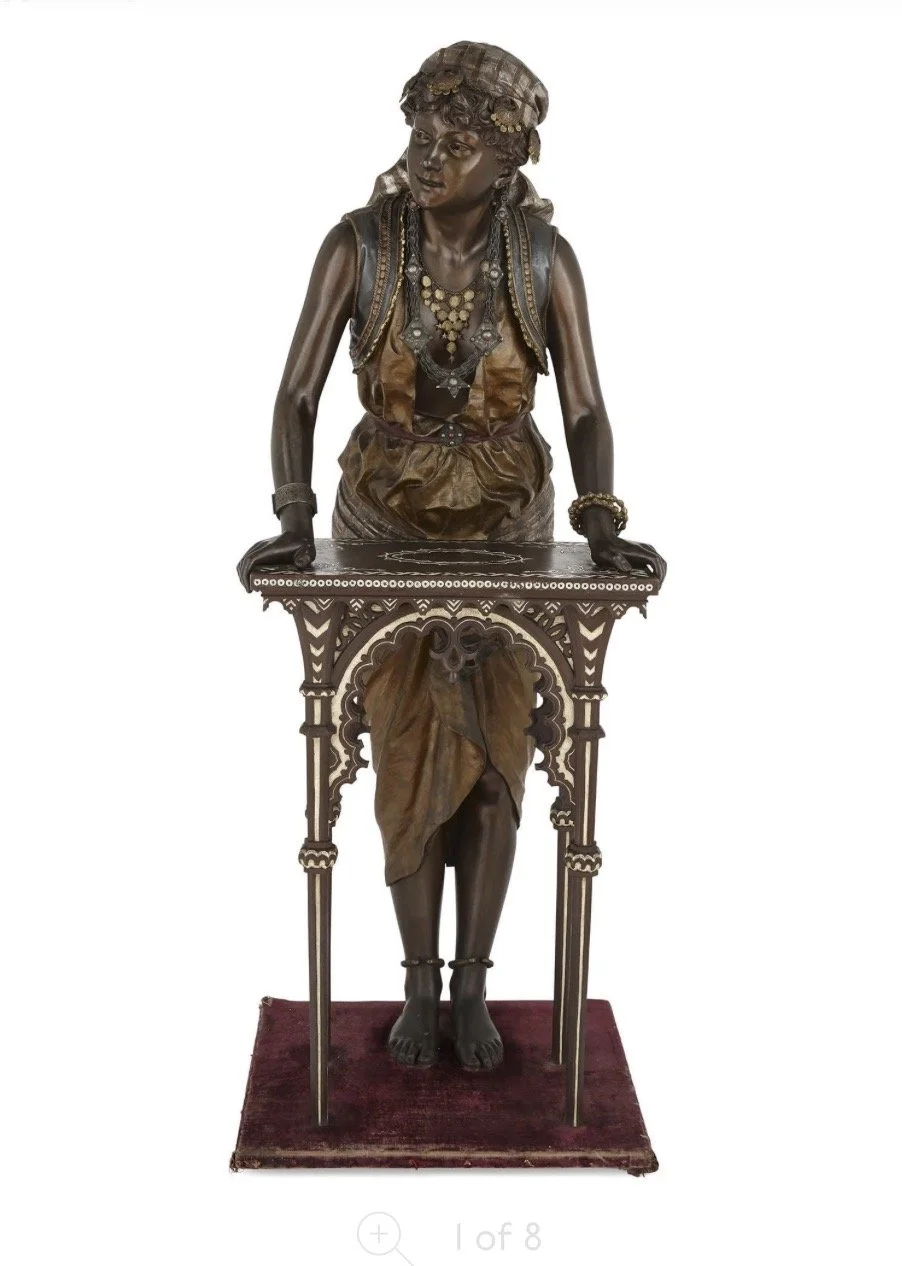
Louis Hottot, Fortune Teller, Calling Card Stand, Late 19th Century
Louis Hottot, French (1829-1905)
Polychrome Spelter, signed.
This imposing figure reflects the nineteenth-century European fascination with Orientalism. A woman in richly patterned dress and head covering leans forward against an elaborate architectural stand, her relaxed pose contrasting with the intricate ornament sculpture surrounding her.
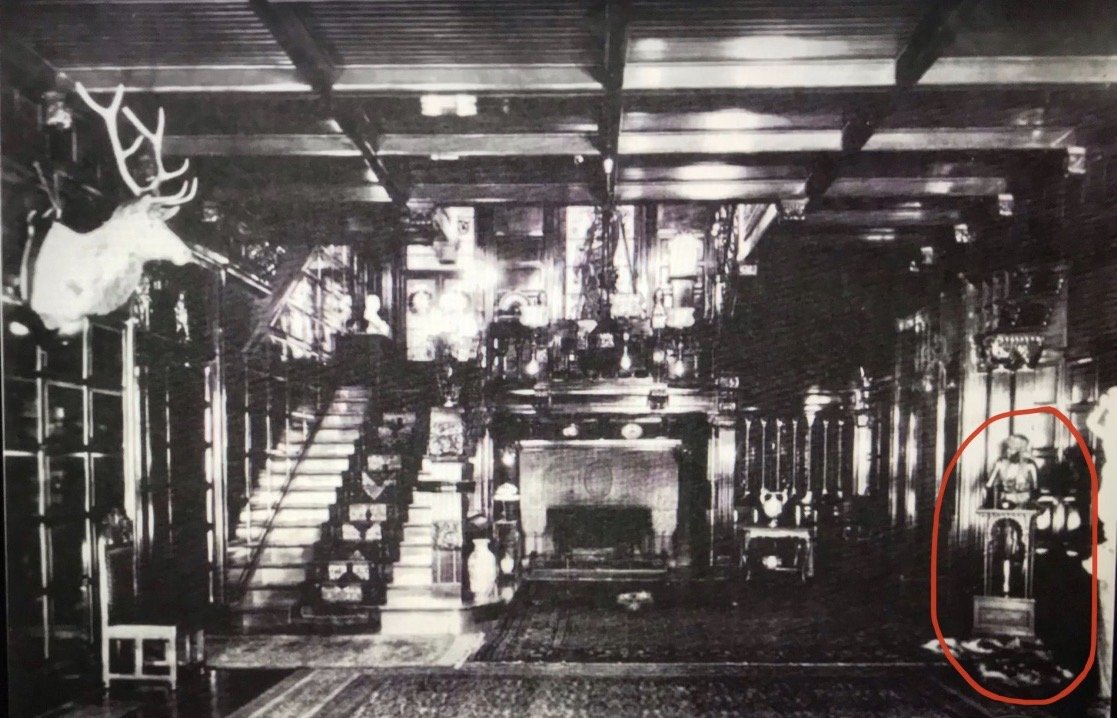
Hottot specialized in romanticized representations of North African and Middle Eastern subjects. Here, costume, jewelry, bare feet, and the Moorish-inspired stand create the sense of an exotic setting that appealed strongly to Victorian audiences. Such works were intended less as ethnographic portraits than as European fantasies of distant cultures, shaped by travel, literature, international exhibitions, and the Orientalist movement in painting and decorative arts. Numerous examples of this influence are evident throughout the house.
The Victorian Calling Card Stand
In the Victorian era, calling cards were an essential part of social etiquette. Visitors arriving at a fashionable home presented a small engraved card bearing their name, which might be handed to a servant or left for the household if the recipient was unavailable. The cards helped announce visitors, document calls (solicitors), and navigate the elaborate rules governing introductions and social visits.
Calling card stands — or card receivers — were therefore commonly placed in entrance halls and parlors, where they became decorative objects in their own right. Manufacturers transformed a practical household accessory into an opportunity for conspicuous display, producing examples in silver, bronze, cast iron, ceramics, and spelter, often incorporating elaborate figural sculpture.
By the later nineteenth century, increasing theatrical examples reflected fashionable artistic movements such as Orientalism, Japanese Revival, and the Moorish Revival movements. In a large figural stand such as this one, the practical tray for receiving a visitor’s card becomes almost secondary to the sculpture itself. Positioned near the entrance of a Victorian home, it served simultaneously as a useful household object and an immediate statement of the owner’s taste, sophistication, and social aspirations.
Sylvester T. Everett house, 4111 Euclid Avenue, Cleveland, OH.