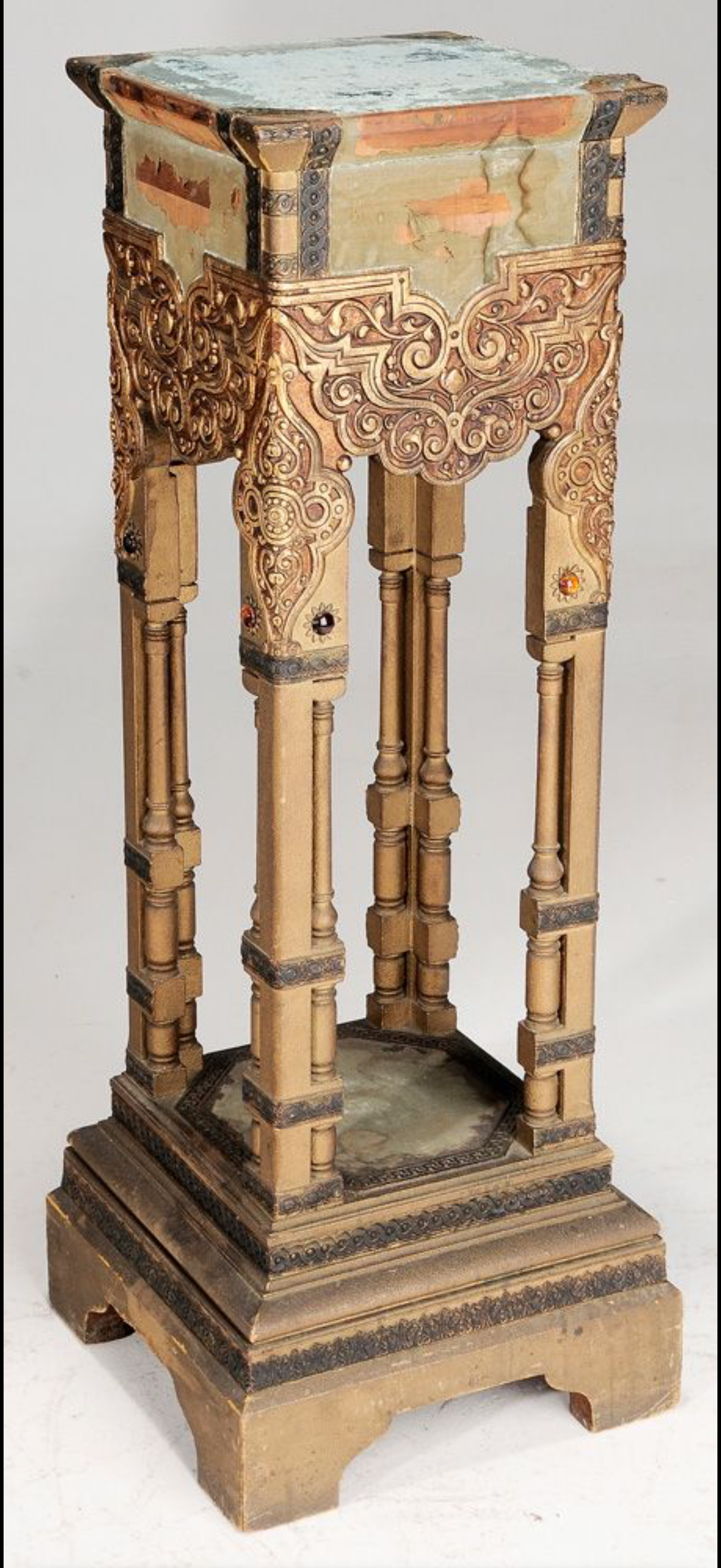
Pedestal, attributed to Herter Brothers, c. 1880-1885
Rectangular wood pedestal embellished with gilded gesso and pressed leather with blue velvet-covered surface rising on four square legs. Ornate Moorish-inspired illusionistic lambrequins on either side below the top. Colored glass cabochons inset on either side.
An apparently identical pedestal, dated c. 1885, is in the collection of the Brooklyn Museum. These materials and decorative vocabulary closely parallel documented work by Herter Brother, the celebrated New York decorating and furniture firm. Although neither this pedestal nor the Brooklyn Museum example bears a makers mark, the close relationship to documented Herter work supports an attribution to the firm.
The Moorish Revival
During the second half of the nineteenth century, American and European designers became fascinated with the architecture and decorative arts of the islamic world. The resulting Moorish Revival drew inspiration from Spain’s Alhambra as well as North African and Middle Eastern design, introducing intricate arabesques, arches, geometric patterns, brilliant color, and jewel-like ornament into fashionable Victorian interiors.
By the 1870s and 1880s, leading American firms such as Herter Brothers incorporated these exotic influences into sophisticated Aesthetic Movement interiors. This pedestal reflects that taste particularly well, with its pierced arabesque ornament, slender colonnettes, gilding, richly decorated surfaces and colored glass cabochons. Such pieces brought an intentionally exotic note to the layered, eclectic interiors of America’s Gilded Age.