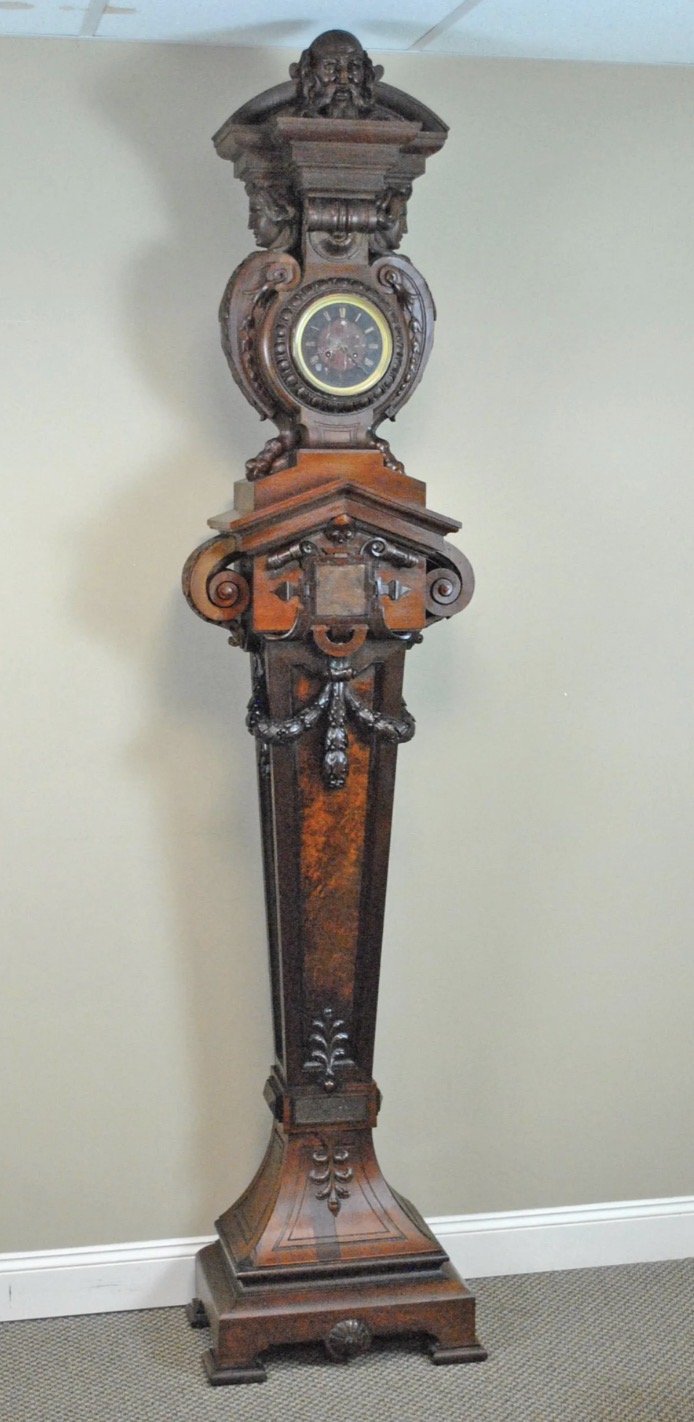
Gustave Herter Tall Case Clock
Gustave Herter (German/American, 1830-1898), circa 1860
Stone and painted dial marked “G. Herter New York”, movement stamped “G. Herter New York 22423/16.2” Walnut, burlwood, carved and applied decoration
Nearly eight feet tall, this imposing tall-case clock was created by Gustave Herter, one of the leading cabinetmakers working in New York during the mid-nineteenth century. Its architectural case combines richly figured burlwood with deeply carved ornament, giving the clock the presence of a piece of monumental furniture rather than simply a timepiece.
The circular dial is framed by opposing caryatid figures, whose elongated forms rise through scrolling foliage and terminate in exuberant acanthus carvings. Swags of bellflowers and other classical ornament surround the dial, while the lower case is enlivened by panels of richly figured burlwood, carved scrollwork, and a garland of laurel leaves and berries. At the summit, a dramatically carved depiction of father time projects above the pediment, providing a sculptural culmination to the case.
Gustave Herter
The clock reflects Herter’s characteristic ability to combine architectural form, elaborate carving, contrasting woodds, and historically inspired ornament into a unified design. Classical and Renaissance-derived motifs are freely combined rather than copied literally, producing the richly layered visual effect that distinguished the most ambitious American furniture of the period.
Both the dial and movement bear the name “G. Herter New York”, firmly associating the clock with Herter’s New York establishment. Dating to the 1860s, it belogs to the earlier phase of his career, before his partnership with his brother Christian resulted in the celebrated firm of Herter Brothers.
Additional examples of his work in this room include the parlor suite with winged figures and hooved feet.