Emanuele Caroni Marble Sculpture
Emanuele Caroni, Florence, Italy (18 -18),
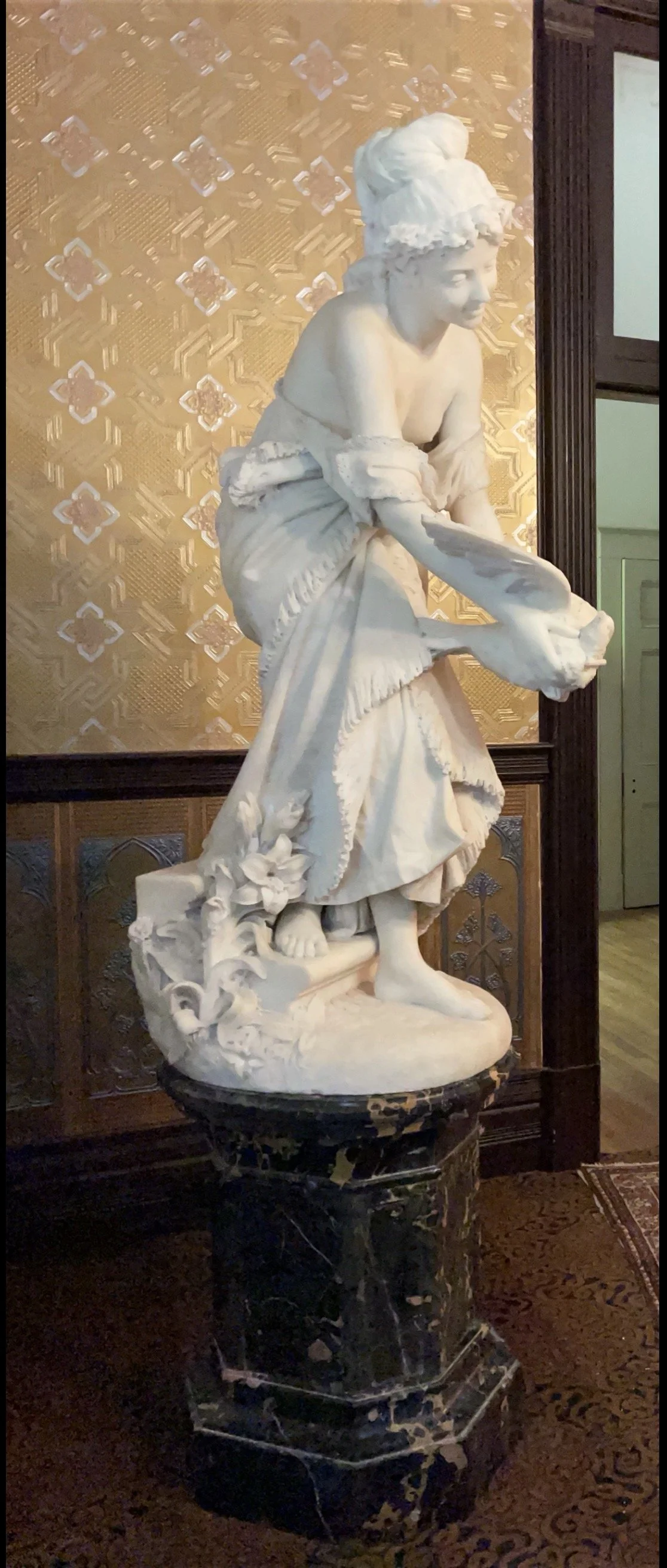
Love’s Messenger, 1875, exhibited at the Philadelphia Centennial International Exhibition, 1876. Exhibited at the Mark Hopkins Museum, San Francisco, 1876-1906
Carved in white Carrara marble, Emanuele Caroni’s Love’s Messenger captures athe instant before a young woman releases a dove carrying a message to her beloved. She holds the bird firmly but gently in both hands, extending it before her as its broad wings spread in readiness for the flight. A small rolled message is secured to the bird.
The young woman leans forward with the effort and anticipation of releasing the bird. Her face, however, is remarkably serene. With her head slightly tilted and a faint smile playing across her features, she appears confident rather than anxious — a quality noted by a contemporary critic who described Caroni’s maiden as hopeful and free from doubt or despondency.
Caroni lavished particular attention on the contrast between the living forms and their different textures. The dove’s individually carved feathers and powerful outstretched wings are set against the smooth modeling of the woman’s face, shoulders, arms, and bare foot. Her loosely arranged curls frame her face, while her elaborate dressing gown slips from one shoulder and cascades around her body in deeply carved folds, finished with fringes, embroidery, and delicate ornament. A contemporary account sepcifically admired Caroni’s rendering of the flowered silk dressing gown, and extraordinary demonstration of his ability to make hard marble suggest soft and richly patterned fabric.
Emanuele Caroni, Florence, Italy (1826-documented through 1878)
An Italian sculptor associated with the flourishing marble workshops of nineteenth-Century Florence. Born in Northern Italy, he first studied with the celebrated sculptor Vincenzo Vela in Milan and later continued his training in Florence under Lorenzo Bartolini, one of the most influential Italian sculptors of the period. He subsequently established his own studio in Florence.
Caroni participated in the revolutionary Five Days of Milan in 1848, fighting against Austrian rule before returning to Florence and pursuing his career as a sculptor. He later received the rank of Knight of the Order of the Crown of Italy.
After the Philadelphia Centennial Exhibition
Purchased at the Centennial by Mrs. A.E. Head of San Francisco, a significant early California/Nevada mining investor and an associate of George Hearst. When the Washoe/Comstock excitement began in 1859, Hearst traveled to Nevada with a small party that included mining expert Melville Attwood, Judge Walsh, and A.E. Heard. The group acquired interests in the newly developing silver lode, soon to become an epic producer of silver.
The sculpture was on loan to the Mark Hopkins Museum, where it resided at the time of the 1906 San Francisco earthquake and fire on the morning of April 18. Though the mansion that housed the collection survived the initial tremors, the extensive gas lines feeding residences and businesses throughout the city caught fire. The Hopkins museum stood at the very top of Nob Hill. With no gas main shutoffs, the fire could be seen jumping from building to building and slowly consuming everything in its wake. Ruptured water lines made firefighting extraordinarily difficult. From Nob Hill, witnesses watched the fire, eventually determining that the flames were moving steadily toward the institute. Museum officials began preparing to remove the most valuable works, but wagons simply could not e obtained amid the disaster, severely limiting what could be evacuated. Employees began carrying works out of the museum, paintings were cut from their frames so that they could be carried more quickly. Some were carried across the bay to Berkeley. Others were taken by employees to distant parts of San Fransico.
Early on April 19, fire consumed the institute, described as being like a furnace. Despite firefighters pumping water first from the city cistern and then from a reservoir inside the institute grounds, the institute, and then the main mansion, Mark Hopkins’ home, were both destroyed.
The official 1906 report said that some statuary and other articles only partially injured were also recovered after the fire in the immediate vicinity of the institute. “Some three or four marbles were also saved.” It is likely that this sculpture was in residence at the time of the fire, the evidence is baked into its pores, as viewing it through a bright light, the soot can still be seen in the deepest crevices of the marble.
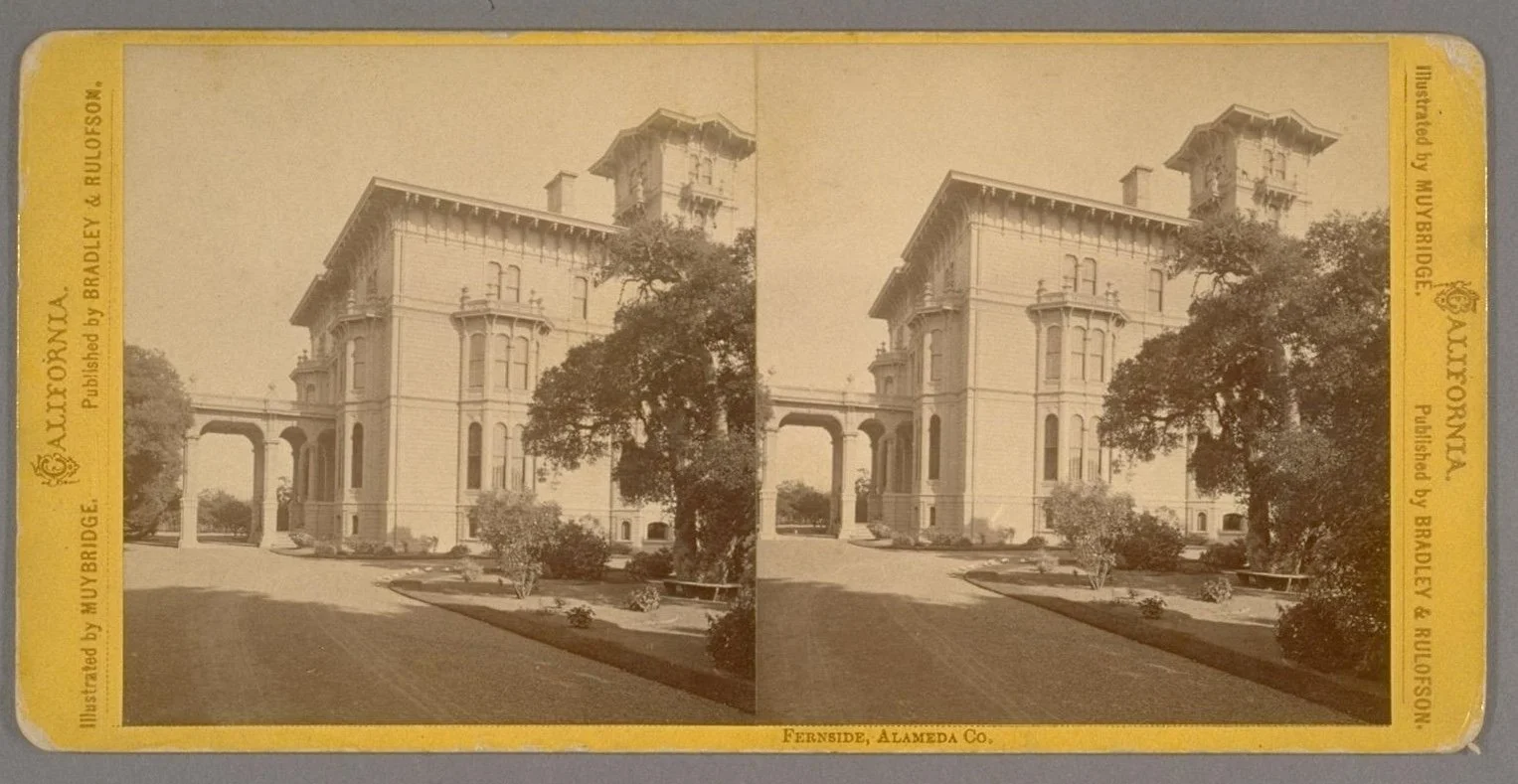
Fernside, Alameda, California, photographed by Eadweard Muybridge, 1870s. Courtesy UC Berkeley, Bancroft Library.