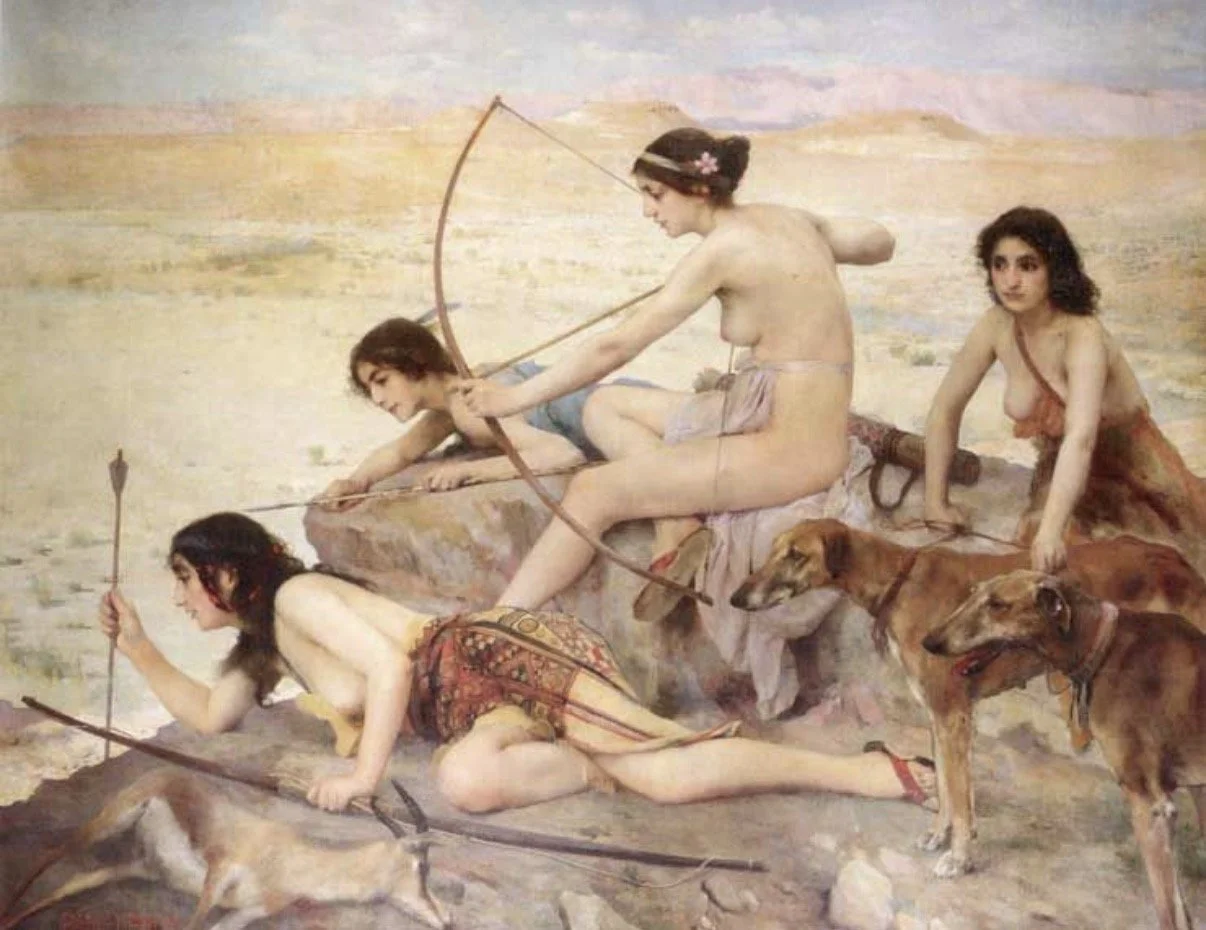
The Daughters of Atlas
Paul Alexandre-Alfred Leroy, French (1860-1942). Les Filles d’Atlas (The Daughters of Atlas), 1896
Oil on Canvas
Exhibited at the Paris, Salon, 1896, no. 1244.
Exhibited at the Exposition Internationale de Bruxelles, 1897, No. 246
This monumental Oil on Canvas reflects Leroy’s longstanding fascination with North Aftrica, where he traveled repeatedly during the 1880s and 1890s. Rather than placing his mythological subjects in a conventional classical setting, Leroy presents the daughters of Atlas as huntresses within the arid landscape of North Africa, combining classical mythology with the Orientalist imagery that characterized much of his work.
The Artist
French by birth, Le Roy spent much of his childhood in Odessa, where his father conducted business, before returning to Paris at seventeen. He studied at the École des Beaux-Arts and became associated with Georges Landelle and his father, the Orientalist painter Charles Landelle.
Leroy traveled extensively in the Mediterranean and North Africa, visiting Turkey and Egypt in 1884 and Tunisia and Algeria the following year. He returned to Algeria repeatedly during the 1880s and 1890s, learning Arabic with fellow painter Etienne Dinet and filling his Paris studio with North African art, objects, and costumes. These experiences became a defining influence on his work.
A regular exhibitor at the Paris Salon, Leroy produced religious, historical, mythological, and portrait subjects, frequently incorporating North African settings and imagery. Les Filles d'Atlas, exhibited at the Salon of 1896, is among his most ambitious examples of this combination.
The Subjects
Traditionally known as the Pleiades, the seven daughters of the titan Atlas and the sea nymph Pleione were nymphs in Artemis' train and, together with the seven Hyades, were the caretakers of the infant Bacchus. When Atlas was forced to hold the heavens on his shoulders, Zeus transformed the Pleiades into doves, then stars, to keep their father company in the sky (and to keep the daughters away from desiring men). Beyond the evident beauty of the maidens, Le Roy's work lacks a direct narrative connection with the mythological tale—or the work of Le Roy's fellow artists, such as William Bouguereau, who painted the daughters in more expected ways, floating in a star-filled sky, their loose tresses covering their supple bodies. Rather than employing Greco-Roman overtones, Le Roy's Pleiades are dark-haired huntresses, wearing cloth woven with tribal patterns, keenly watching for prey, waiting to release sharp arrows and long spears to add to their kill of a young gazelle. Contemporary audiences appreciated this mixture of exotic beauty and wild strength and how the work's Orientalist elements innovated the well-known tale and its visual tropes. The writer Thiébault-Sisson thrilled over Les Filles d'Atlas, "girls who dominate the plains" set against a realistically depicted arid, desert, "orientalist landscape" that demonstrated Le Roy's "understanding of the Algerian environment that he loved. All is executed in a harmonious and soft quality, and one wonders at the marvel of the nudes with their fresh and pink complexions" (p. 26).